
AI Crawler for Tolls & Emission Zones.
Toll prices and low emission zone rules are published on hundreds of government, regional and municipal websites, often as PDFs or interactive forms. We built a proof of concept that collects them automatically, spots every change, and turns it into a report a person can check in minutes.
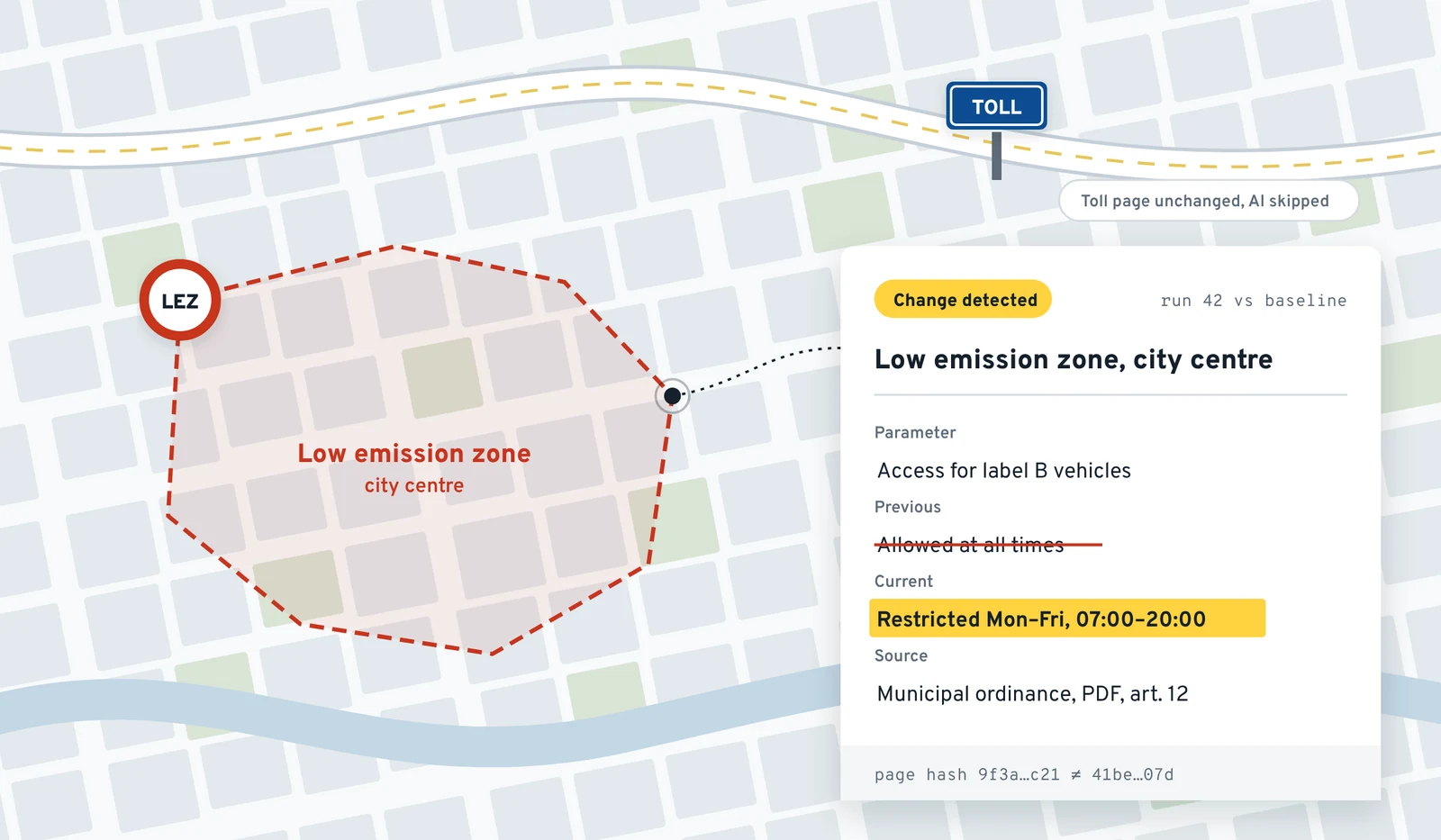
Hundreds of sources, no common format.
Large mobility and navigation platforms depend on accurate, current information about toll charges and low emission zone (LEZ) regulations in many countries. That information lives on government portals, regional environmental platforms and municipal websites, inside interactive forms, dynamically rendered pages and PDF legal documents.
Monitoring all of it by hand doesn't scale, and every missed update is a business risk: outdated prices, wrong access restrictions and regulatory non-compliance.
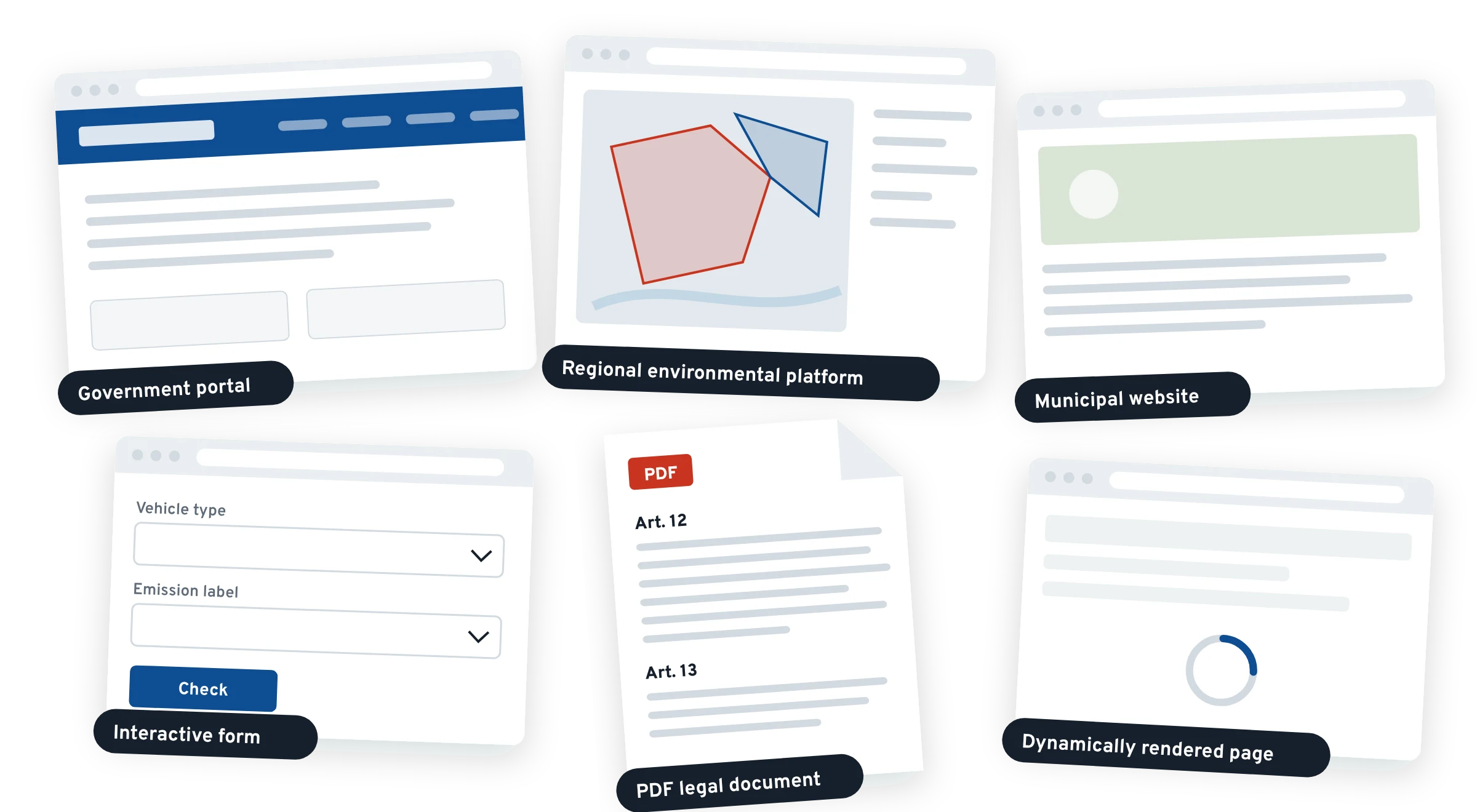
Could an AI-assisted crawler do it automatically?
The client asked us to validate whether an AI-assisted crawler could take over the monitoring end to end. The proof of concept had to show three things.
Extract the data: pull toll and LEZ data from diverse official sources, without manual copying.
Detect what changed: compare each run with the last and find the deltas over time.
Report it clearly: produce structured, readable reports showing what changed, where and when.
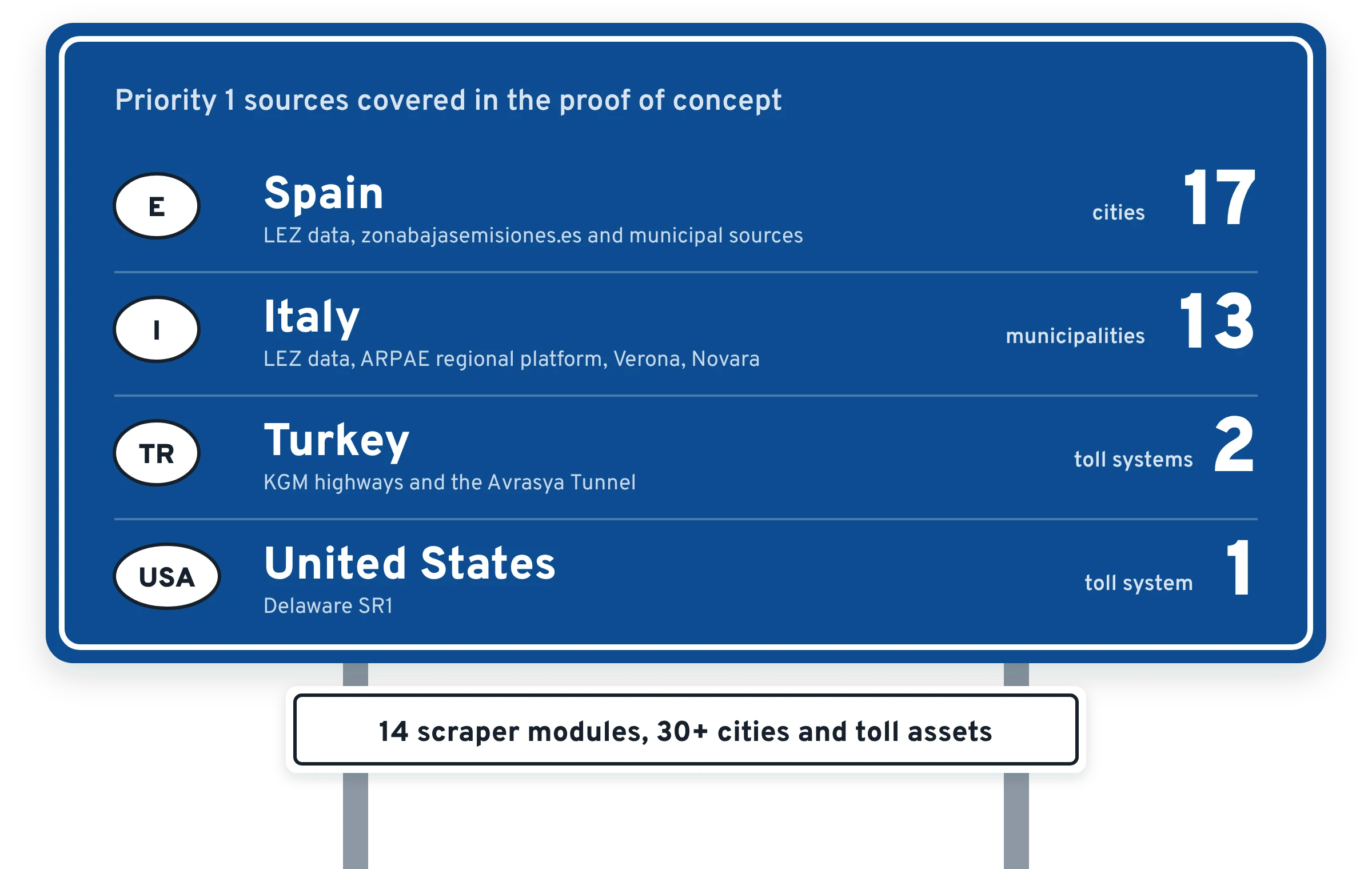
Four countries, the most important sources first.
During the proof of concept we built 14 production-ready scraper modules covering more than 30 cities and toll assets.
The scope deliberately focused on Priority 1 sources, to prove feasibility, robustness and data quality before going for full geographic coverage.
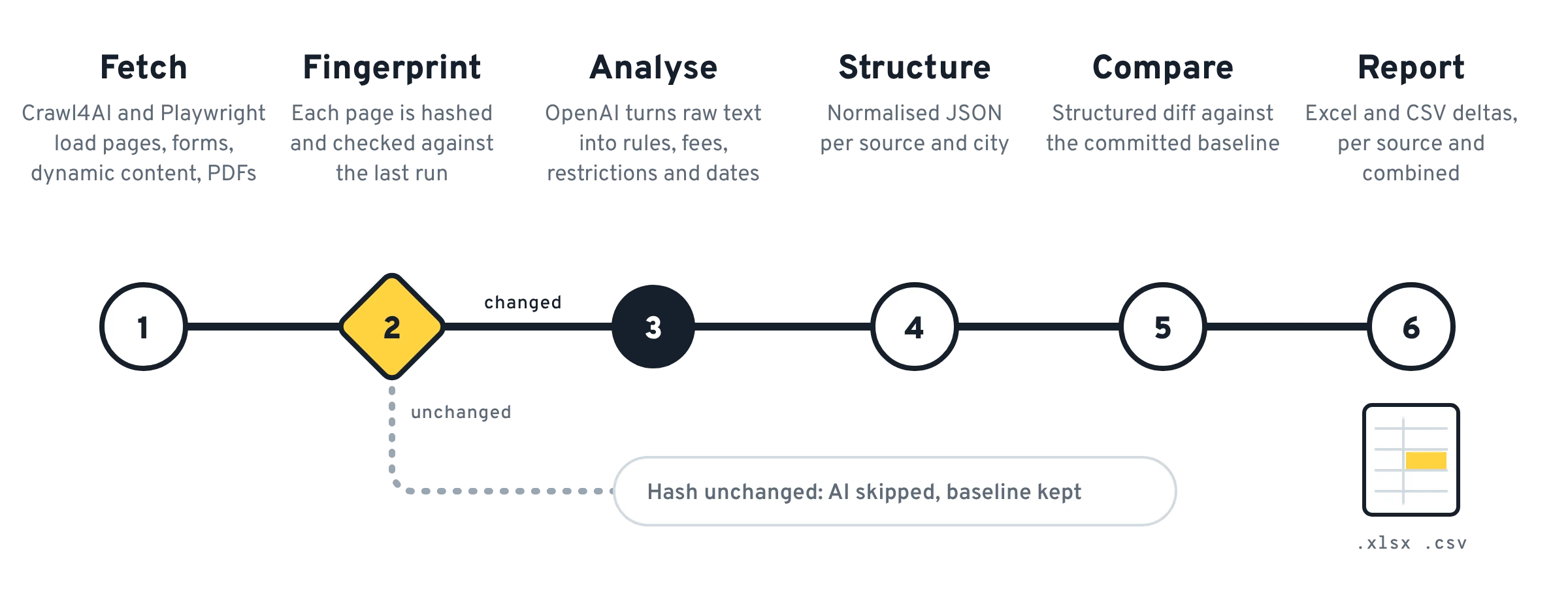
Scrapers collect. AI reads. A diff reports.
Deterministic scrapers do the collecting and AI does the reading. A hash check in between decides whether the AI needs to look at a page at all, and a structured diff turns the results into a list of changes.
Five building blocks, one modular system.
Paying for AI only when a page changes.
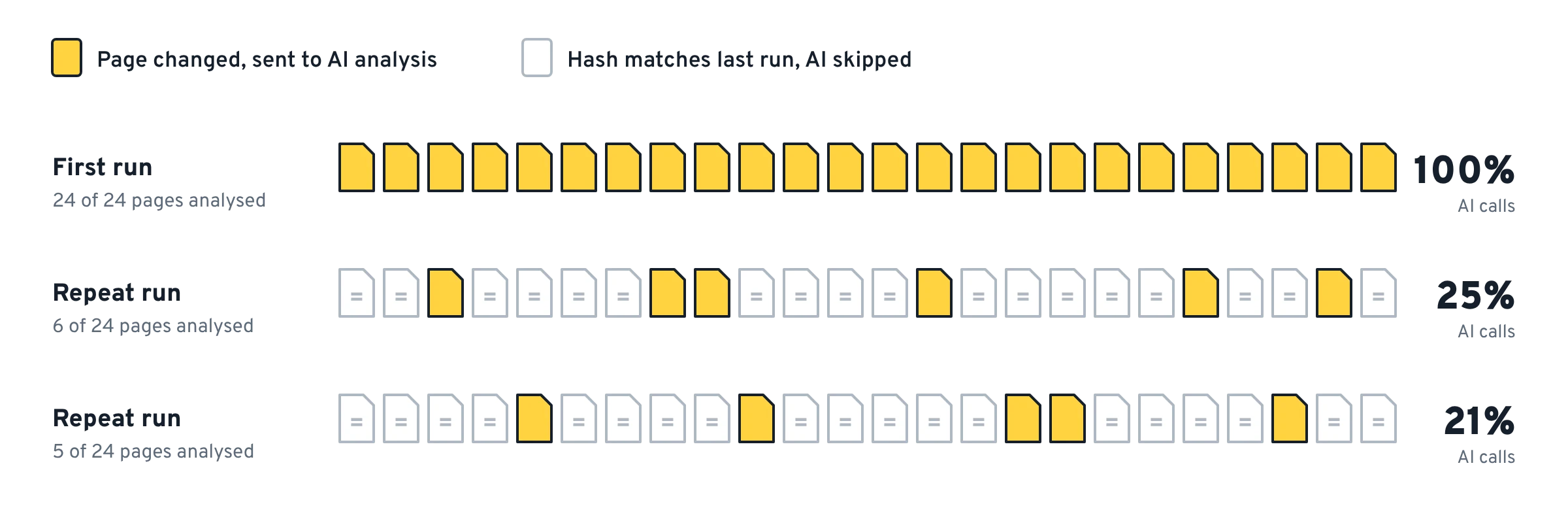
Most regulatory pages don't change from one run to the next. Each page gets a fingerprint, and if it matches the previous run the page skips AI analysis completely and the last result is kept.
That cuts AI costs by roughly 70–80% on repeat runs, which makes frequent, recurring monitoring affordable.
Reports a reviewer can act on.
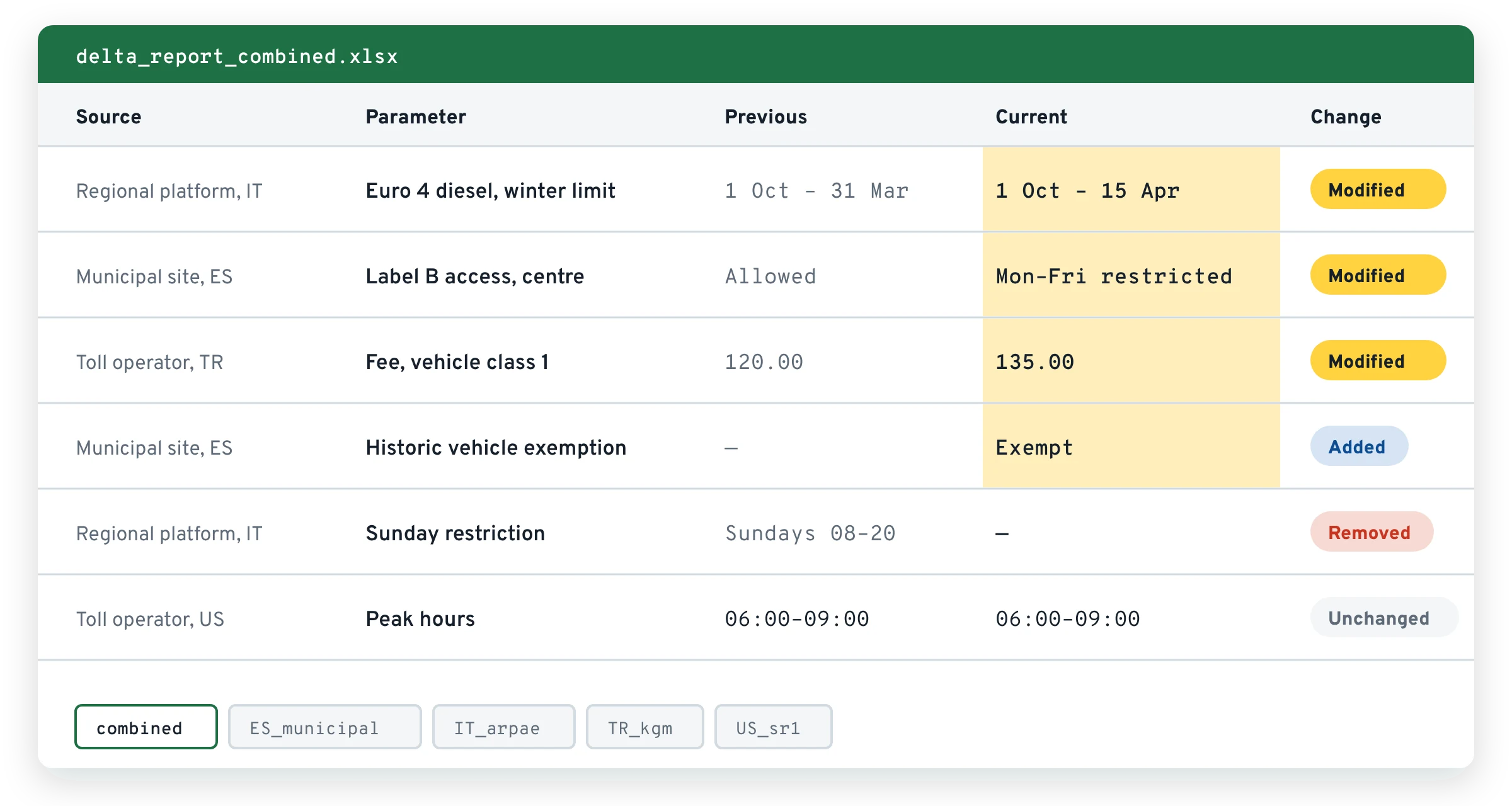
Every source gets its own delta report in Excel and CSV, plus a combined report across all sources.
Each row shows the affected parameter, the previous value and the current one, so a reviewer can confirm a change without opening the original website.
What made it hard, and how we solved it.
Every source behaves differently, so the crawler had to cope with a wide range of structures, formats and access rules.
Very different website structures: a tailored scraping strategy for each standalone site, and unified scrapers for platforms that publish many cities in one place.
Geo-blocked sources: some sources, especially in the United States, only answer local visitors. Proxy-based access solved this.
Dynamic content and interactive elements: pages that render in the browser or hide data behind forms are handled with browser-based scraping through Playwright.
PDF-heavy legal documentation: reliable extraction and parsing of PDF documents before the text reaches AI analysis.
Websites that change often: a modular design means one scraper can be fixed or refactored without touching the others.
What the proof of concept showed.
Automated monitoring of toll and LEZ rules across several countries is technically feasible, and affordable to run on a schedule.
A proven foundation, ready to scale.
The proof of concept validates a robust and scalable approach to automated regulatory monitoring in the mobility domain.
Each extension can be delivered on its own, as business priorities require.
By combining deterministic scraping with AI analysis and cost-aware change detection, the crawler gives enterprises a reliable way to keep toll and LEZ intelligence up to date.