Fintech · Engineering case
Offline Payments: How We Built Phone-to-Phone Transfers for a Fintech Company
Can two people send money phone to phone when neither has internet? A fintech company asked us. Here is how we built the proof of concept, and the security decisions behind it.
The short answer
Yes. With offline payments, two phones can exchange a signed payment over NFC with no internet, and a server checks it later. In a proof of concept that Generic Soft, a software development company in Sofia, Bulgaria, built for a fintech company, the phones tap over NFC using Host Card Emulation, both sign the payment with one-time keys and keep it encrypted on the device. When a phone reconnects, the server verifies the signatures and updates the balances.
Short on time? See how a payment works.
A fintech company came to us with one question: could its users make offline payments, phone to phone, with no internet at all?
It is not a niche question. More than 3.4 billion people still do not use mobile internet (GSMA, September 2026), and many people who do have smartphones still lose signal in basements, on trains or in rural areas. Even in Europe, offline payments are on the agenda: the European Central Bank says people could use the planned digital euro “even when they have poor or no network reception” (ECB FAQ).
Our cross-platform mobile development team built a proof of concept to find out. Payments travel over NFC, stay encrypted on the device and reach the server once a phone is back online. This is how we built it, and the security decisions that shaped it.
What are offline payments?
Offline payments are payments that complete when the payer, the payee or both have no connection. The BIS Project Polaris handbook describes three modes (BIS Innovation Hub, May 2023):
- Fully offline: the payee can spend the money straight away, and neither side ever has to connect.
- Intermittently offline: the same, but devices may need to sync from time to time to keep working.
- Staged offline: value is exchanged offline but only becomes final once the payee connects.
The difference matters for risk: the more final a payment is offline, the stronger the device security has to be.
This is different from a card terminal’s offline mode, where a merchant device stores card payments to submit later. Here both sides are ordinary phones.
Why are offline payments hard?
An online payment has a referee. The server checks the balance, approves the transfer and records it, all in a second or two. Offline, there is no referee in the room. The two phones have to trust what they can verify themselves until one of them reaches the server again.
That raises three questions every offline payment system has to answer:
- Is the payment real? The receiver needs to know it wasn’t copied, edited or forged.
- Can the same money be spent twice? This is double spending: paying with the same balance twice before anyone can check. Before the phones sync, nobody can check the balance online. In the central bank survey in the BIS Project Polaris handbook, double spending and criminal attacks were rated the greatest risks of offline payments (BIS Innovation Hub, May 2023, Annex B).
- What if a phone is lost? A payment and the keys on a lost phone must not leak, and the system has to account for payments that never synced.
Everything else in the design follows from these three answers.
How does a phone-to-phone payment work without internet?
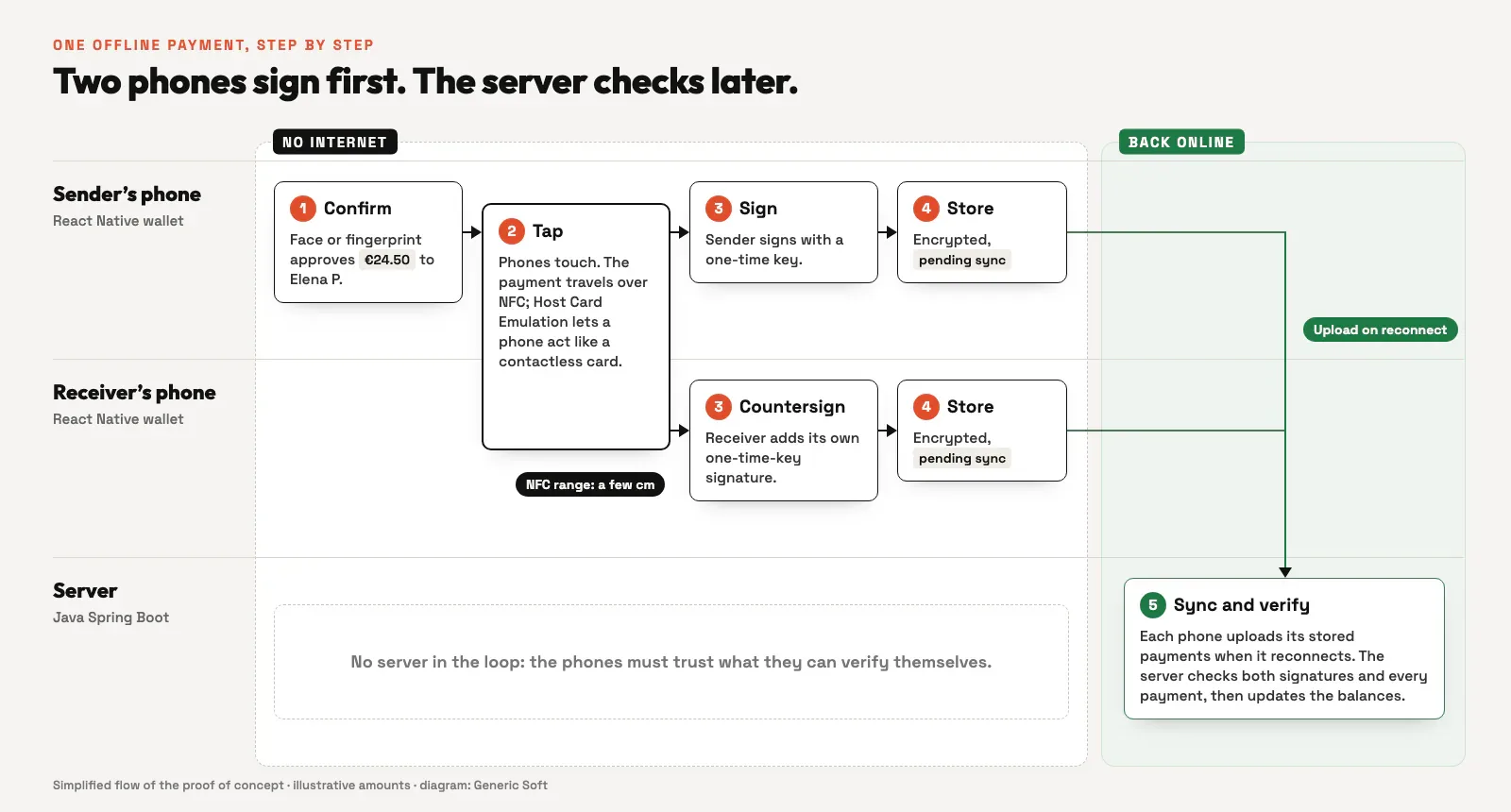
One offline payment takes five steps:
- The sender confirms. The wallet asks for a fingerprint or face scan, so only someone enrolled on the phone can approve the amount.
- The phones tap. The payment travels over NFC. Host Card Emulation lets one phone act like a contactless card, with no extra hardware, while the other reads it.
- Both sides sign. The sender and the receiver each sign the payment with a one-time key that signs only that payment.
- The payment is stored encrypted. It waits on the device, marked as pending, until it can sync.
- The server checks it. When a phone reconnects, it uploads its stored payments. The server checks both signatures and updates the balances.
Here is what the two phones actually exchange in that tap, simplified:
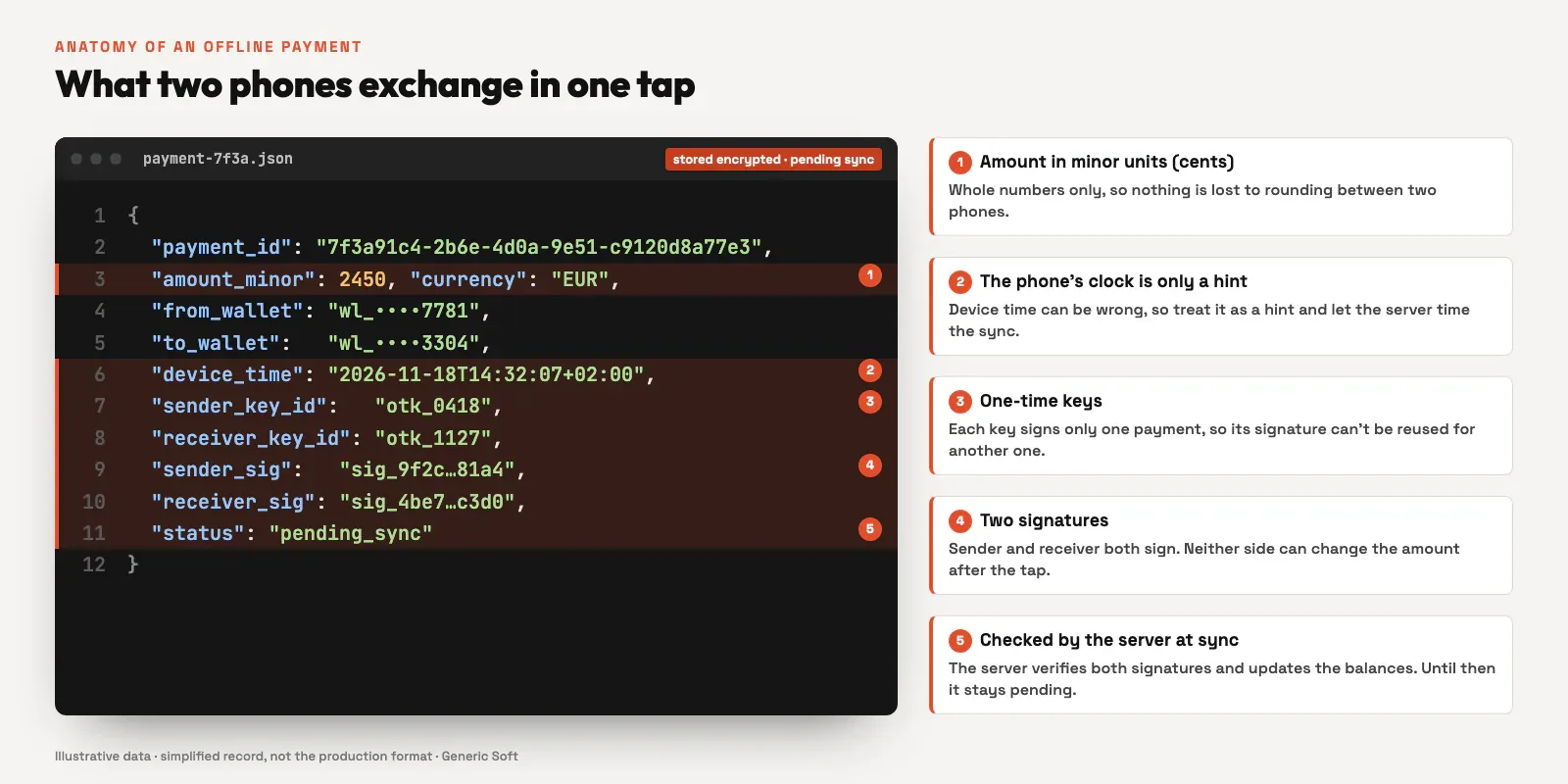
Each payment carries both signatures and is stored encrypted on the device until it syncs. Offline, the receiver can’t confirm the sender’s balance. It trusts the signatures until the server checks them. Two details we recommend to any team: store amounts in minor units (cents), so two phones never disagree about rounding, and treat the phone’s clock as a hint only, because device time can be wrong.
NFC payment app development: Host Card Emulation on Android and iPhone
Host Card Emulation (HCE) is a phone feature that lets an app act as a contactless card without a separate secure element chip, and it is the piece that makes phone-to-phone offline payments practical on Android. Android’s guide notes that another Android phone can act as the reader, so the whole exchange can run between two phones. Without HCE, card emulation on Android phones usually runs on a separate secure element chip; since Android 4.4, any app can emulate a card and talk to the NFC reader directly (Android Developers).
Two numbers shape the experience. NFC typically needs a distance of 4 cm or less to connect (Android Developers), so a tap is a deliberate act and hard to trigger by accident. And Android’s HCE guide calls about 1 KB a reasonable upper bound for one tap, which can usually be exchanged within 300 ms (Android Developers). A compact signed payment record fits in that.
iPhone is a different story, and it matters for any NFC payment app development plan:
- In the European Economic Area, third-party apps can use HCE for NFC transactions on iPhone XS or later with iOS 17.4 or later, with Apple’s HCE entitlement and commitments to the applicable security and privacy standards (for example PCI DSS and EMVCo for in-store payments, and GDPR). Apple lists device-to-device transactions among the permitted uses, for providers with the necessary regulatory permissions (Apple Developer, HCE-based contactless transactions).
- Outside the EEA, Apple’s NFC & SE Platform is open to developers established in 49 territories, including the US, UK, Canada and Japan (as of November 2026). It runs on the secure element, not HCE, and needs a commercial agreement with Apple. None of its listed use cases (in-store payments, keys, transit, tickets and similar) is device-to-device (Apple Developer).
So check the route market by market before you promise iPhone users a phone-to-phone tap. Our Android app developers and iOS app developers can help you map it.
The security decisions we made, and what they cost
With money moving and no server in the loop, security decided most of the design. These were the main choices and the trade-off each one brought.
| Decision | Why we made it | The trade-off |
|---|---|---|
| Dual signatures with one-time keys | Any edit breaks the signatures, and the server’s transaction validation checks every payment at sync | More key management on every device |
| Encrypted local storage | Payments and keys stay encrypted if a phone is lost or stolen | Encryption keys need careful handling on each device |
| Biometric login | Only a person enrolled on the phone’s biometrics can approve a payment | A fallback is needed for phones without biometrics |
| Server check at sync | The server has the final say on every payment | A bad payment is only caught once a phone syncs |
The hardest question is always double spending. Signatures stop a payment from being altered, one-time keys tie each signature to a single payment, and the server check at sync detects a double spend, but only after the fact. For a production system, the BIS handbook describes two more layers: tamper-resistant devices for keys and value (a secure element, a trusted execution environment or secure software), and offline limits on the value and number of payments before a device must go online again (BIS Project Polaris, pp. 55 and 61). How high those limits are is a business decision as much as a technical one. And for a fully offline system, the handbook treats a high degree of device tamper resistance as a key requirement, so plan for it before a proof of concept becomes a product.
Every offline payment has to carry its own proof, because no server is there to vouch for it.
Beyond the tap: the wallet, React Native app and Spring Boot backend
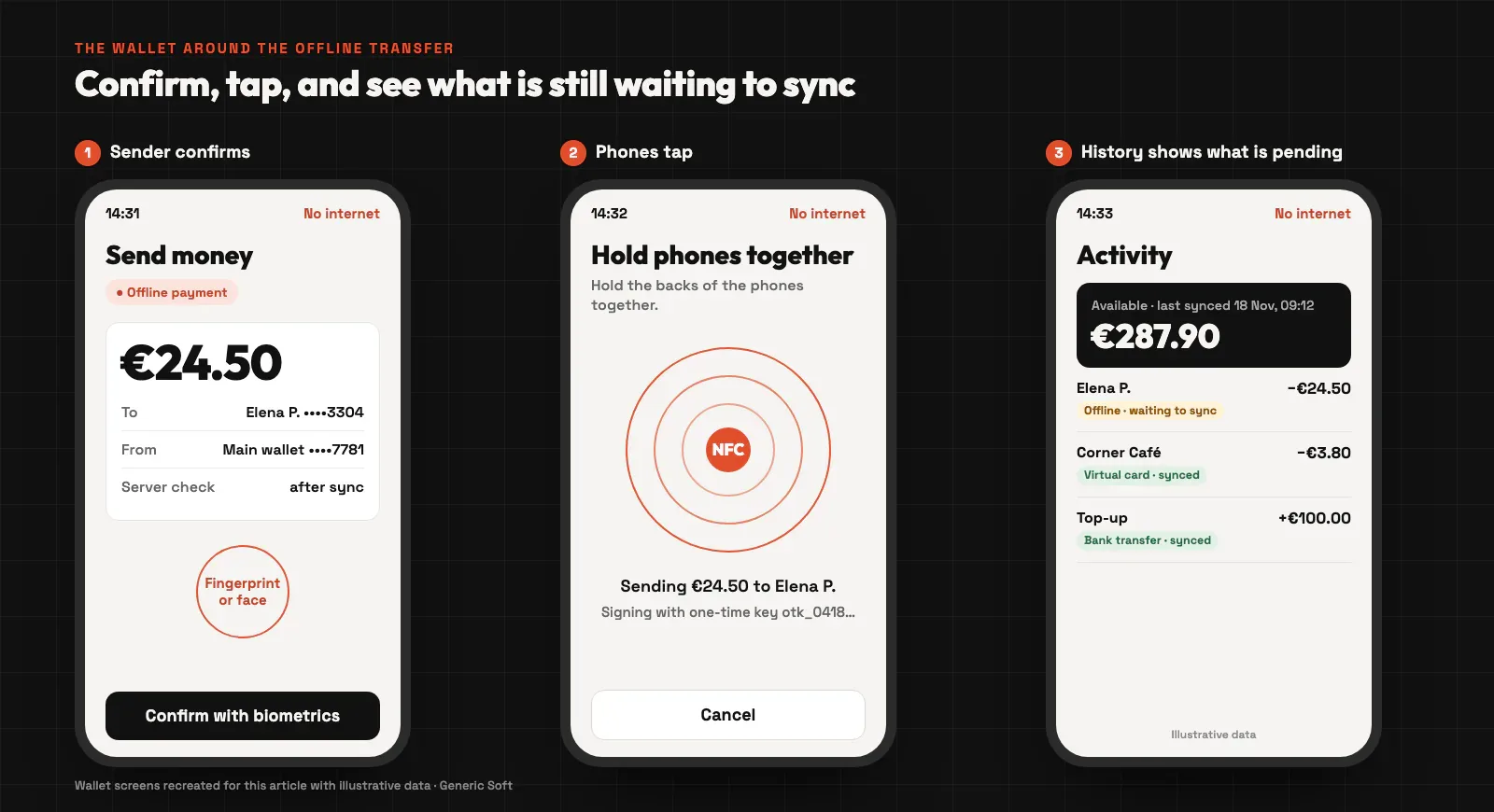
Around the offline transfer, we built a working wallet so the proof of concept felt like a real product, not a lab demo:
- secure offline peer-to-peer transfers over NFC;
- real-time balance updates and payment history when online;
- biometric authentication for access and approval;
- virtual card payments;
- automatic sync of offline payments when a device reconnects;
- a validation system that checks every payment on the server.
The mobile app is built in React Native, so one codebase covers Android and iOS. The backend that verifies, records and syncs payments is Java Spring Boot. If you are weighing a cross-platform app for a product like this, our team builds both the app and the backend services behind it.
Planning offline payments or an NFC wallet? Talk to our mobile team about the NFC route, sync design and offline limits before you build.
What the offline payments proof of concept proved
The proof of concept did its job: it showed that phone-to-phone payments without internet are technically feasible on NFC-enabled phones. The wallet runs from one React Native codebase for Android and iOS. Which phones can do the tap in production depends on the platform rules covered above: HCE is open to apps on Android, while on iPhone it is limited to the EEA and needs Apple’s entitlement. The client could validate its approach: signed peer-to-peer transfers where any change after the tap breaks the signatures and are checked by the server at sync.
On the technical side, the team delivered:
- working offline-to-offline data transfer between two phones;
- secure, encrypted local storage of payments and keys;
- a sync that sends stored payments to the server for checking when a device reconnects;
- a simple interface for what is, underneath, a complex financial transaction.
About this project: written by the Generic Soft mobile and backend engineers who built it. It was a proof of concept with a React Native app for Android and iOS, NFC with Host Card Emulation and a Java Spring Boot backend, built for a fintech company we don’t name in this post. We’ll add test figures from the proof of concept once they are cleared for publication.
A proof of concept is the cheapest moment to learn what a product really needs. For the project summary, tech stack and features, read the offline payments case study. If you are at that stage with your own idea, see how we approach MVP development, or browse our case studies.
Five things we’d tell any team planning offline payments
- Design the sync before the tap. The tap is the fun part to demo, but the hard questions all land when the phones reconnect.
- Decide your offline limits early. How much money can move before a server sees it is a risk decision. Agree on it with compliance before you write code.
- Treat the phone’s clock and memory as untrusted. Store amounts in cents so phones never disagree on rounding, sign everything, and let the server record the real time.
- Check NFC rules per platform and market. HCE is open on Android, but on iPhone the route depends on the region and needs Apple’s approval.
- Test on real phones. NFC antennas sit in different places on different models, and emulators won’t show you how a real tap feels.
Frequently asked questions
What are offline payments?
Offline payments are payments made when the payer, the payee or both have no internet connection. The devices exchange a payment directly, for example over NFC, keep a secure record of it and report it to the server later, when one of them is back online.
How do you stop double spending in offline payments?
No single trick does it. In our proof of concept each payment is signed by both phones with one-time keys, so any change after the tap breaks the signatures, and the server has the final say when the phones sync. Detection happens at sync, so in a production system offline limits are what cap the risk before then. For fully offline systems, the BIS Project Polaris handbook treats highly tamper-resistant devices as a key requirement.
What is Host Card Emulation (HCE)?
Host Card Emulation lets an app make a phone behave like a contactless card without a separate secure element chip. Android has supported it since version 4.4. On iPhone, third-party apps can use HCE for NFC transactions only in the European Economic Area, on iPhone XS or later with iOS 17.4 or later, and with Apple’s HCE entitlement.
Can offline NFC payments work on both Android and iPhone?
The app itself can: we built one React Native codebase for Android and iOS. The NFC part depends on the platform and the market. On Android, any app can use HCE on phones with NFC and HCE support, while on iPhone the route depends on the region and needs Apple’s approval, so check it for every country you plan to launch in.
Which technologies did you use for the offline payments proof of concept?
A React Native mobile app for Android and iOS, NFC with Host Card Emulation for the phone-to-phone transfer, encrypted local storage on the device, biometric authentication, and a Java Spring Boot backend that verifies, records and syncs the payments.
Planning offline or NFC payments? Let’s talk
Planning NFC payment app development, a wallet or another fintech product? Generic Soft is a software development company from Sofia that builds mobile apps, backends and complete products for clients across Europe, with 60+ projects delivered across 11+ sectors, including fintech software development.
Schedule a call with our fintech and mobile team: tell us what you are building and where you plan to launch, and we’ll help you map the NFC route for Android and iPhone. Follow us on LinkedIn for our next fintech engineering post.
Last updated: