Generic Soft

Engineering teams built around your needs — from solo engineers to full-scale squads.

SOFTWARE DEVELOPMENT Custom Software Development Web Application Development Backend Development Frontend Development E-commerce Development MVP Development SaaS Development UX/UI Design AI & MOBILE Machine Learning Deep Learning Computer Vision Natural Language Processing Agentic AI LLM Integration iOS App Development Android App Development Cross-Platform App Development CLOUD, QA & DATA Cloud Migration Cloud Architecture DevOps & CI/CD Cybersecurity Software Testing & QA Automation Testing Business Intelligence Big Data CRM All Services → OUR PRODUCTS
MSGPLS Viber business messaging

Sell more in every chat Support that never sleeps Every delivery in the loop Campaigns people answer

Product offers, cart reminders and checkout — right inside Viber, where your customers already are.

Boost my sales
INSECTARIUM-X TRL 7 Automated Bio-Protection

Precise Microclimate Remote Control Full Traceability Autonomous Operation

Automated management of temperature, humidity, lighting, and ventilation for reliable breeding of beneficial bioagents.

Request a Demo

We've delivered 60+ projects across 11+ sectors. Experience in your industry? We have it.

Agriculture Banking Fintech Insurance Healthcare Real Estate Logistics IoT AI Cybersecurity Blockchain All Industries → Careers Technologies Our Work Blog

MSGPLS series · Part 1

Custom Software vs SaaS: Why We Built MSGPLS

We kept building the same Viber tool for different clients. So we built it once, for everyone.

Generic Soft team 8 min read

The short answer

Custom software fits one company’s process exactly. SaaS is faster to start and cheaper, because many companies share it. You don’t always have to choose. MSGPLS, the Viber business messaging platform built by Generic Soft, a software development company in Sofia, started as the custom tool we kept rebuilding for clients. Now it’s one product, and we still build custom work on top of it.

Short on time? Jump to the comparison table.
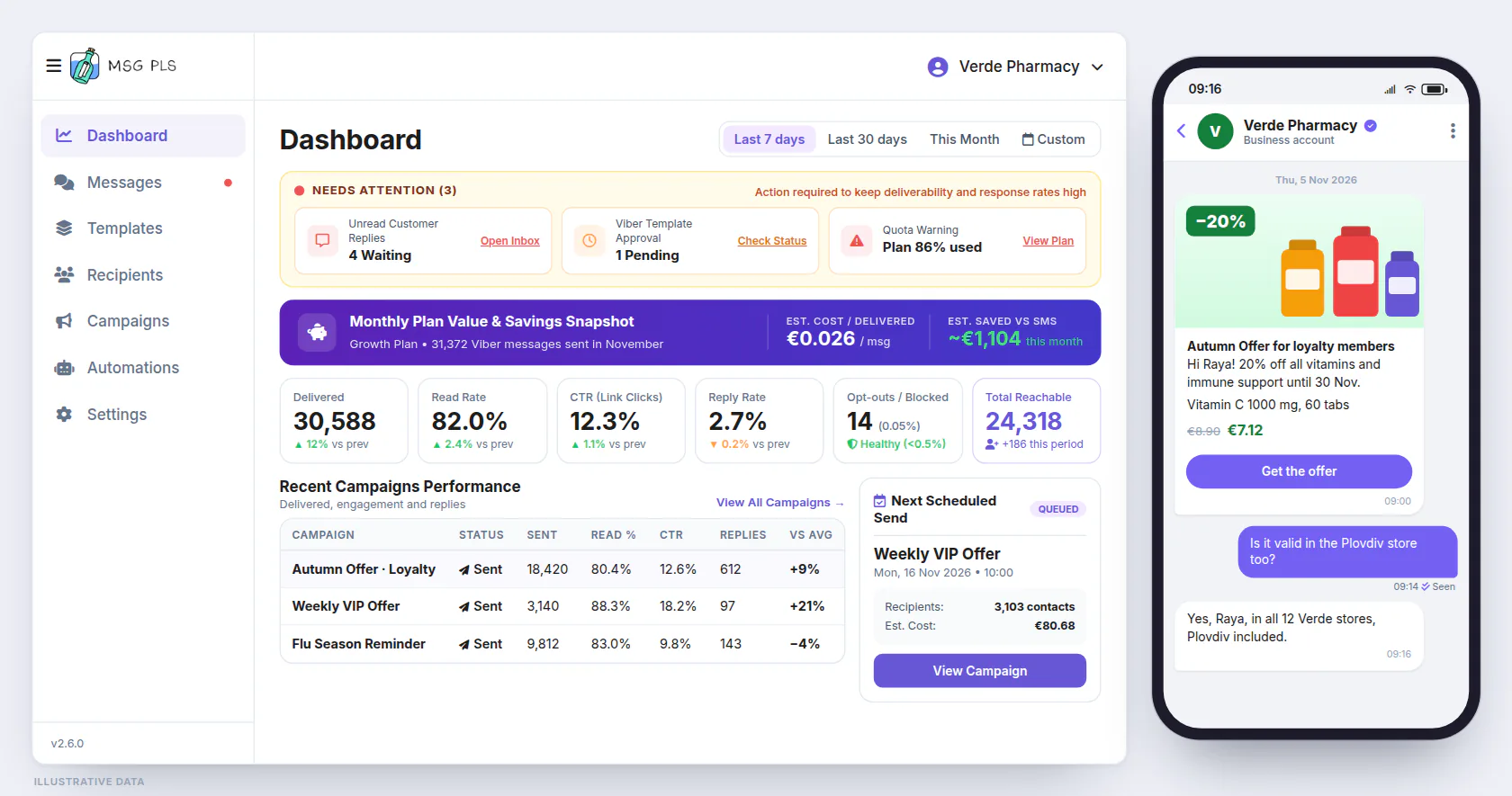
MSG PLS dashboard with the Autumn Offer campaign results (delivered, read rate, CTR, replies) next to a Viber Business chat showing the same offer and a customer reply
The MSG PLS dashboard on the left, the same campaign on your customer’s phone on the right. Illustration based on the product, illustrative data.

Most of our work starts with a phone call and a problem that belongs to one company.

A distributor wants its warehouse system to talk to its accounting software. A lab wants a climate chamber that runs itself. We build it, we hand it over, and the next project is something completely different.

Then one request started coming back. Different clients, different industries, almost the same words.

“Can we send our customers messages on Viber?”

This is the story of how that question settled the custom software vs SaaS debate for us, at least for one problem that kept coming back.

The message people actually open

Ask someone in Bulgaria where they read messages from their family, and the answer usually isn’t email. It’s Viber.

Email still works for receipts and newsletters. But a promotional email lands in a tab nobody checks, and an SMS is a line of plain text that looks a lot like this week’s scam text. A Viber message from a business shows up in the same app as messages from your mum, with the company’s name on it, a picture and a button you can tap.

Businesses got that straight away. What they struggled with was everything around it.

Where our clients kept getting stuck

Sending one Viber message is easy. Sending the right one to 20,000 people at 9 o’clock on a Thursday, and knowing afterwards how many of them saw it, is not.

Every client ran into the same walls:

We solved these for one client, then for the next, a little differently each time. At some point it got hard to ignore. We were writing the same software over and over.

Building it once: how we turned custom software into SaaS

Turning custom software into SaaS means keeping what every client needs, dropping one client’s habits, and adding what a shared platform needs.

Custom software has one nice luxury: it only has to make one company happy. You know their people, their data and their quirks. If something looks odd, you call them.

A product doesn’t get that luxury. It has to make sense to a pharmacy chain and a courier company on the same Monday morning, without us standing behind anyone’s chair.

So the switch came with some hard choices.
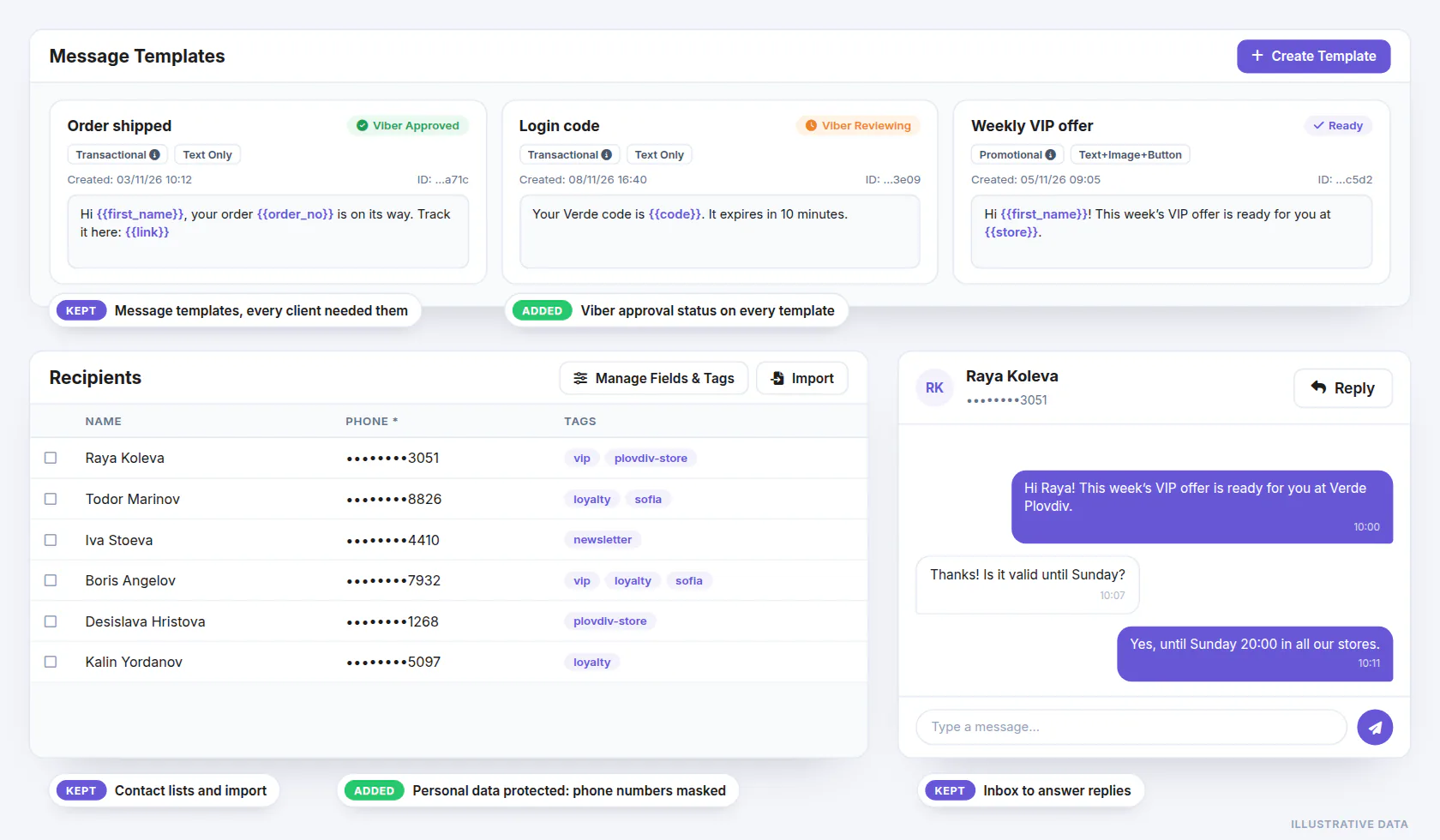
MSGPLS Templates, Recipients and Messages screens marked with what we kept from the custom builds and what we added for the product
What every custom build had in common went into the product, plus what a shared platform needs. Illustration based on the product, illustrative data.

What we kept

The parts every client needed, every single time: message templates, contact lists, campaigns, delivery reports and a way to answer replies. We’d built versions of these often enough to know which details matter. People don’t just want “send now”. They want “send next Tuesday at 10” and “send every Monday morning”.

What we threw away

The screens and shortcuts that were built around one client’s habits. If a feature only made sense for one company, it didn’t make it into the product. (It didn’t vanish, either. More on that below.)

What we added

The things you only need once many businesses share one platform. An approval step, so nothing goes out by accident. Pricing that works for a small shop and for a large sender. And protection for the personal data sitting in your contact lists.

What it looks like from your side
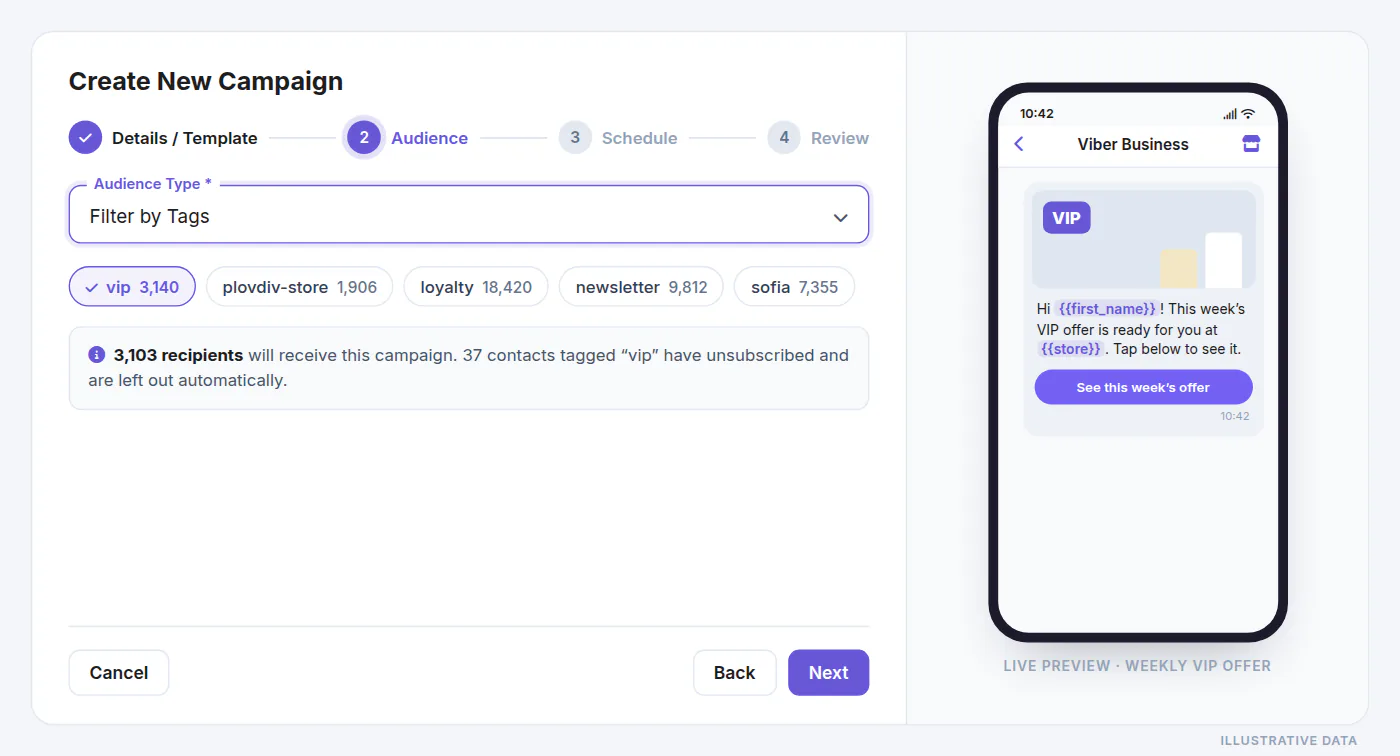
MSGPLS Create New Campaign wizard at the Audience step (details and template, audience, schedule, review) with a live Viber Business phone preview
Four steps from idea to sent campaign. The phone preview shows what your customer will see. Illustration based on the product, illustrative data.

You log in to a web dashboard. There’s nothing to install.

Two things are set up once, before your first campaign:

Then every campaign takes four steps:

  1. Details and template. Name the campaign and pick the message. A phone preview shows you exactly what your customer will see, and you can drop in each person’s name or any other detail from your list.
  2. Audience. Everyone, a group tagged “vip” or “plovdiv-store”, or a hand-picked list. Anyone who has unsubscribed is left out automatically, so you don’t have to remember who they were.
  3. Schedule. Send right now, or at a set time.
  4. Review. Check the name, message, audience and timing on one screen, then create the campaign.

Once it’s out, you watch the numbers come in: delivered, seen, replied. And when a customer writes back, the reply lands in an inbox where your team can answer it like any other chat.

For the bigger jobs, like login codes or order updates sent straight from your own systems, there’s an API your developers can connect to.

Want to see it with your own contact list?

If you want the details of Viber’s message types and rules, the MSGPLS team explains them in Viber business messages: what they are and how they work (in Bulgarian).

You shouldn’t need a developer to send a Viber campaign. And when you do need one, ours is a phone call away.

Custom software vs SaaS: the part a typical SaaS tool can’t offer

This is where being a custom software development company pays off for you.

Most messaging tools are what they are. If your process doesn’t fit the tool, you change your process.

With us, the platform is the starting point. Maybe your messages need to be triggered by an old ERP that nobody else connects to. Maybe your finance team wants a report in a very particular shape. The people who built the platform can build that for you. Same team, same code, no middleman.

Remember the one-off features we threw out of the product? That’s where they went. On top of it, for the client who actually needs them.
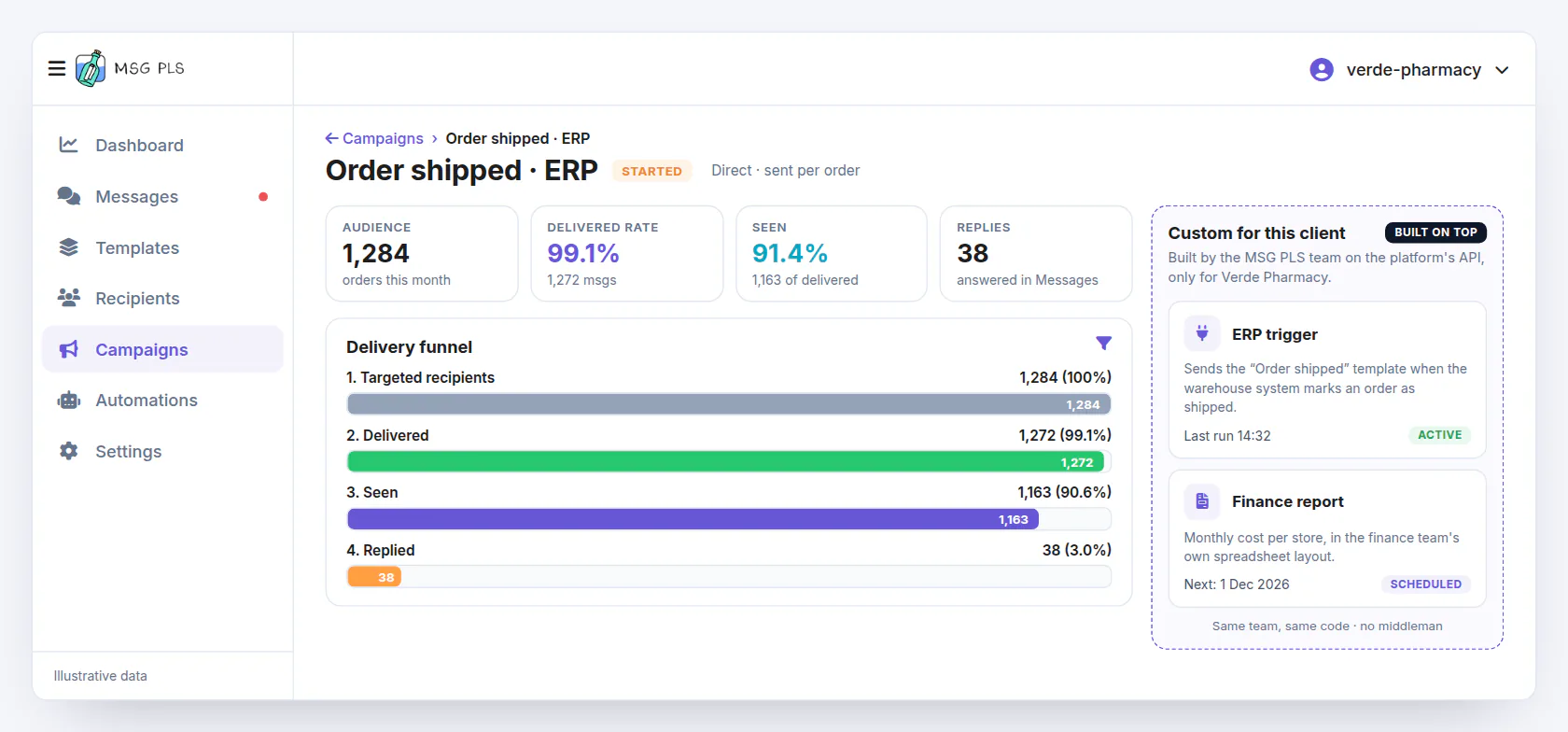
MSGPLS campaign report with a separate panel of custom work built for one client: an ERP trigger and a monthly finance report
The same product for everyone, with one client’s custom pieces built on top by the same team. Illustration based on the product, illustrative data.

Build vs buy software: do you still have to choose?

The classic build vs buy software question assumes two options: build your own and own every line, or buy a subscription and live with its limits. Generic Soft is a software development company from Sofia that builds custom software, AI solutions and dedicated engineering teams, and MSGPLS gave us a third option to offer.

Custom software vs SaaS vs a product with custom work on top
Custom softwareTypical SaaS toolProduct + custom work (MSGPLS)
Time to startMonths of buildingSign up and startNo build needed, just Viber sender approval; extras when you need them
Fits your processExactlyYou adapt to the toolThe product fits most of it; custom work covers the rest
Upfront costHigh: you pay for everythingLow: a subscriptionSubscription, plus only the custom parts
Who maintains itYou, or your vendorThe vendor, on its own roadmapThe team that built the platform
Best forA process nobody else hasA standard job done the standard wayA common job with a few unusual parts

If your problem is truly unique, build it. If it’s standard, buy it. If it’s standard with a twist, like most Viber messaging we see, start with the product and pay only for the twist. Our SaaS development team uses the same thinking when a client wants to turn their own internal tool into a product.

What comes next in the MSGPLS series

This is the first in a series of articles about MSGPLS. Next, we’ll look at why Viber messages get read when email doesn’t, how automated messages can take routine work off your team, and how to connect the platform to the systems you already use.

We’re also working on automated flows, like a birthday message or an appointment reminder that goes out on its own. We’ll write about those when they’re ready, not before.

Frequently asked questions

What is the difference between custom software and SaaS?

Custom software is built for one company and fits its process exactly, but it takes longer and costs more upfront. SaaS (software as a service) is one product shared by many companies through a subscription: quick to start and cheaper, but you adapt to the tool rather than the other way round.

When does it make sense to turn custom software into SaaS?

When different clients keep asking for the same thing in almost the same words. That’s what happened with Viber messaging for us. Keep the parts every client needs, drop the habits of any single client, and add what a shared platform needs, such as approvals, pricing and data protection.

What is MSGPLS?

MSGPLS is a Viber business messaging platform built by Generic Soft. Businesses use a web dashboard to import contacts, write messages with a phone preview, get Viber’s approval, schedule campaigns, follow delivered, seen and replied numbers, and answer replies in an inbox. An API connects it to your own systems.

How long does Viber take to approve a business message?

Order updates and one-time codes need a template that Viber approves before it goes out. The review usually takes about 10 to 15 minutes and can take up to 24 hours. Promotional messages don’t use these templates.

Can MSGPLS be customised for my business?

Yes. The team that built the platform also builds custom work on top of it, for example a connection to an ERP system or a report in the exact shape your finance team needs.

Let’s talk

The quickest way to find out if this fits your business is to see it. We’ll walk you through the platform with your own case in mind, whether that’s a weekly promotion, delivery notices or verification codes.

Follow us on LinkedIn

We used to build that Viber tool again for every client who asked. Now we can just show it to you. Read more about the platform at msgpls.com.

MSGPLS Viber business messaging

Sell more in every chat Support that never sleeps Every delivery in the loop Campaigns people answer

Product offers, cart reminders and checkout — right inside Viber, where your customers already are.

Boost my sales

Last updated:

Keep exploring.

All articles →
Blog

We Built a Better Home for the Bugs That Eat Pests

Why a software company spent 18 months on a climate chamber for beneficial insects, and where it could go next.

Read the article
Service

Custom Software Development

Software built around your process, by senior engineers.

See the service
Service

SaaS Development

Turn an internal tool into a product other companies pay for.

See the service

MSGPLS series · Part 1

Custom Software vs SaaS: Why We Built MSGPLS

We kept building the same Viber tool for different clients. So we built it once, for everyone.

The short answer

Custom software fits one company’s process exactly. SaaS is faster to start and cheaper, because many companies share it. You don’t always have to choose. MSGPLS, the Viber business messaging platform built by Generic Soft, a software development company in Sofia, started as the custom tool we kept rebuilding for clients. Now it’s one product, and we still build custom work on top of it.

Short on time? Jump to the comparison table.

MSG PLS dashboard with the Autumn Offer campaign results (delivered, read rate, CTR, replies) next to a Viber Business chat showing the same offer and a customer reply
The MSG PLS dashboard on the left, the same campaign on your customer’s phone on the right. Illustration based on the product, illustrative data.

Most of our work starts with a phone call and a problem that belongs to one company.

A distributor wants its warehouse system to talk to its accounting software. A lab wants a climate chamber that runs itself. We build it, we hand it over, and the next project is something completely different.

Then one request started coming back. Different clients, different industries, almost the same words.

“Can we send our customers messages on Viber?”

This is the story of how that question settled the custom software vs SaaS debate for us, at least for one problem that kept coming back.

The message people actually open

Ask someone in Bulgaria where they read messages from their family, and the answer usually isn’t email. It’s Viber.

Email still works for receipts and newsletters. But a promotional email lands in a tab nobody checks, and an SMS is a line of plain text that looks a lot like this week’s scam text. A Viber message from a business shows up in the same app as messages from your mum, with the company’s name on it, a picture and a button you can tap.

Businesses got that straight away. What they struggled with was everything around it.

Where our clients kept getting stuck

Sending one Viber message is easy. Sending the right one to 20,000 people at 9 o’clock on a Thursday, and knowing afterwards how many of them saw it, is not.

Every client ran into the same walls:

  • Viber has rules. Order updates and one-time codes have to be approved by Viber before they go out, and a message that breaks a rule simply bounces.
  • Contact lists are messy. Spreadsheets full of duplicates, numbers without a country code, and people who asked not to be contacted again.
  • Nobody knew what happened after “send”. Did it arrive? Did anyone read it? Did they reply, and who’s answering?
  • The marketing team wanted to do all of this themselves, without opening a ticket with IT every time.

We solved these for one client, then for the next, a little differently each time. At some point it got hard to ignore. We were writing the same software over and over.

Building it once: how we turned custom software into SaaS

Turning custom software into SaaS means keeping what every client needs, dropping one client’s habits, and adding what a shared platform needs.

Custom software has one nice luxury: it only has to make one company happy. You know their people, their data and their quirks. If something looks odd, you call them.

A product doesn’t get that luxury. It has to make sense to a pharmacy chain and a courier company on the same Monday morning, without us standing behind anyone’s chair.

So the switch came with some hard choices.

MSGPLS Templates, Recipients and Messages screens marked with what we kept from the custom builds and what we added for the product
What every custom build had in common went into the product, plus what a shared platform needs. Illustration based on the product, illustrative data.

What we kept

The parts every client needed, every single time: message templates, contact lists, campaigns, delivery reports and a way to answer replies. We’d built versions of these often enough to know which details matter. People don’t just want “send now”. They want “send next Tuesday at 10” and “send every Monday morning”.

What we threw away

The screens and shortcuts that were built around one client’s habits. If a feature only made sense for one company, it didn’t make it into the product. (It didn’t vanish, either. More on that below.)

What we added

The things you only need once many businesses share one platform. An approval step, so nothing goes out by accident. Pricing that works for a small shop and for a large sender. And protection for the personal data sitting in your contact lists.

What it looks like from your side

MSGPLS Create New Campaign wizard at the Audience step (details and template, audience, schedule, review) with a live Viber Business phone preview
Four steps from idea to sent campaign. The phone preview shows what your customer will see. Illustration based on the product, illustrative data.

You log in to a web dashboard. There’s nothing to install.

Two things are set up once, before your first campaign:

  • Your contacts. Bring your customer list, as a spreadsheet if that’s what you’ve got. The platform spots duplicates and broken numbers and asks you what to do with them, instead of failing quietly later.
  • Your message template. Plain text, a picture with a button, a short video or a PDF. If Viber needs to approve it first, the platform sends it off for review and shows you where it stands. Viber’s review usually takes about 10 to 15 minutes, and it can take up to 24 hours.

Then every campaign takes four steps:

  1. Details and template. Name the campaign and pick the message. A phone preview shows you exactly what your customer will see, and you can drop in each person’s name or any other detail from your list.
  2. Audience. Everyone, a group tagged “vip” or “plovdiv-store”, or a hand-picked list. Anyone who has unsubscribed is left out automatically, so you don’t have to remember who they were.
  3. Schedule. Send right now, or at a set time.
  4. Review. Check the name, message, audience and timing on one screen, then create the campaign.

Once it’s out, you watch the numbers come in: delivered, seen, replied. And when a customer writes back, the reply lands in an inbox where your team can answer it like any other chat.

For the bigger jobs, like login codes or order updates sent straight from your own systems, there’s an API your developers can connect to.

Want to see it with your own contact list?

If you want the details of Viber’s message types and rules, the MSGPLS team explains them in Viber business messages: what they are and how they work (in Bulgarian).

You shouldn’t need a developer to send a Viber campaign. And when you do need one, ours is a phone call away.

Custom software vs SaaS: the part a typical SaaS tool can’t offer

This is where being a custom software development company pays off for you.

Most messaging tools are what they are. If your process doesn’t fit the tool, you change your process.

With us, the platform is the starting point. Maybe your messages need to be triggered by an old ERP that nobody else connects to. Maybe your finance team wants a report in a very particular shape. The people who built the platform can build that for you. Same team, same code, no middleman.

Remember the one-off features we threw out of the product? That’s where they went. On top of it, for the client who actually needs them.

MSGPLS campaign report with a separate panel of custom work built for one client: an ERP trigger and a monthly finance report
The same product for everyone, with one client’s custom pieces built on top by the same team. Illustration based on the product, illustrative data.

Build vs buy software: do you still have to choose?

The classic build vs buy software question assumes two options: build your own and own every line, or buy a subscription and live with its limits. Generic Soft is a software development company from Sofia that builds custom software, AI solutions and dedicated engineering teams, and MSGPLS gave us a third option to offer.

Custom software vs SaaS vs a product with custom work on top
Custom softwareTypical SaaS toolProduct + custom work (MSGPLS)
Time to startMonths of buildingSign up and startNo build needed, just Viber sender approval; extras when you need them
Fits your processExactlyYou adapt to the toolThe product fits most of it; custom work covers the rest
Upfront costHigh: you pay for everythingLow: a subscriptionSubscription, plus only the custom parts
Who maintains itYou, or your vendorThe vendor, on its own roadmapThe team that built the platform
Best forA process nobody else hasA standard job done the standard wayA common job with a few unusual parts

If your problem is truly unique, build it. If it’s standard, buy it. If it’s standard with a twist, like most Viber messaging we see, start with the product and pay only for the twist. Our SaaS development team uses the same thinking when a client wants to turn their own internal tool into a product.

What comes next in the MSGPLS series

This is the first in a series of articles about MSGPLS. Next, we’ll look at why Viber messages get read when email doesn’t, how automated messages can take routine work off your team, and how to connect the platform to the systems you already use.

We’re also working on automated flows, like a birthday message or an appointment reminder that goes out on its own. We’ll write about those when they’re ready, not before.

Frequently asked questions

What is the difference between custom software and SaaS?

Custom software is built for one company and fits its process exactly, but it takes longer and costs more upfront. SaaS (software as a service) is one product shared by many companies through a subscription: quick to start and cheaper, but you adapt to the tool rather than the other way round.

When does it make sense to turn custom software into SaaS?

When different clients keep asking for the same thing in almost the same words. That’s what happened with Viber messaging for us. Keep the parts every client needs, drop the habits of any single client, and add what a shared platform needs, such as approvals, pricing and data protection.

What is MSGPLS?

MSGPLS is a Viber business messaging platform built by Generic Soft. Businesses use a web dashboard to import contacts, write messages with a phone preview, get Viber’s approval, schedule campaigns, follow delivered, seen and replied numbers, and answer replies in an inbox. An API connects it to your own systems.

How long does Viber take to approve a business message?

Order updates and one-time codes need a template that Viber approves before it goes out. The review usually takes about 10 to 15 minutes and can take up to 24 hours. Promotional messages don’t use these templates.

Can MSGPLS be customised for my business?

Yes. The team that built the platform also builds custom work on top of it, for example a connection to an ERP system or a report in the exact shape your finance team needs.

Let’s talk

The quickest way to find out if this fits your business is to see it. We’ll walk you through the platform with your own case in mind, whether that’s a weekly promotion, delivery notices or verification codes.

Follow us on LinkedIn

We used to build that Viber tool again for every client who asked. Now we can just show it to you. Read more about the platform at msgpls.com.

Last updated:

Keep exploring.

All articles →